Why a Feint Works Before the Ball Moves
A feint works by shaping an opponent’s expectation before the ball moves. Learn to read body position, attention cues, and the response that opens space.
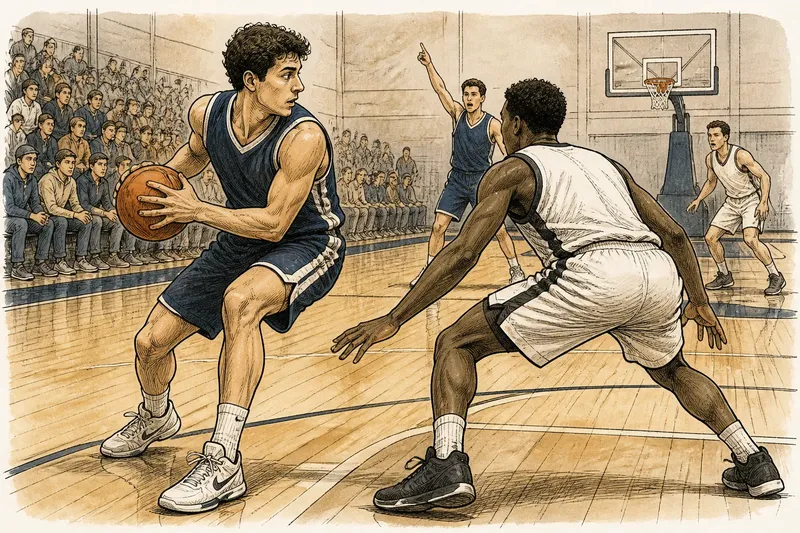
A feint works before the ball moves because an opponent reads your body as well as the ball. In soccer, basketball, or another invasion sport, a slight shift of the hips or a glance toward one route can prompt a defender to prepare for that route. The useful moment comes when the attacker changes direction while the defender is still responding to the first cue.
A feint starts with a believable cue
A fake is persuasive when it resembles the beginning of a real action. If you want a defender to expect a move to your right, your shoulder, hips, and gaze can briefly support that possibility. A theatrical gesture may be easy to spot; a small, purposeful change often gives the opponent less reason to dismiss it.
Body position matters because it offers clues about what you can do next. A planted foot can suggest a push-off, while a lowered center of gravity can make a quick drive look ready. These cues do not dictate what an opponent will choose, but they can influence which option seems urgent.
Attention cues help set the expectation
Players do not watch every part of an opponent equally at every moment. A defender might track the ball, the attacker’s torso, and nearby support players, shifting attention as the play develops. A glance toward a teammate or an open lane can make that option feel relevant, especially if the rest of the attacker’s posture agrees.
For the attacker, the goal is not to hide every intention. It is to make one plausible action briefly compete with the action you actually want. Keep the cue connected to the situation: a fake pass is more credible when a teammate is available, and a fake drive has more meaning when there is room to attack.
Read the opponent’s response, not just your own move
A feint is a conversation with a defender. The attacker offers a cue; the defender adjusts stance, weight, or distance; the attacker responds to that adjustment. If the defender stays balanced and close, forcing the planned second move may run into pressure. If the defender leans or steps toward the fake, the opposite route may open.
Say you are a basketball player on the wing with the ball and a defender squared in front of you. You turn your shoulders as if preparing to pass to a teammate near the top of the key; the defender shifts attention toward that lane, so you keep the ball protected and drive along the space the defender has vacated. The expected observable result is not an automatic score, but a changed defensive position that gives you a different route to assess.
Timing keeps the second action available
If you make the fake too early, the defender has time to reset. If you delay until the defender is already committed to another task, your cue may not matter. A useful feint happens close enough to the decision point that the opponent has to respond while you can still change course.
Control matters more than speed alone. In soccer, a player who keeps the ball within playing distance can turn away after a body fake; a heavy touch may remove that option. In basketball, staying balanced and protecting the ball helps preserve a drive, pass, or retreat if the defender does not bite.
Why does a feint fail?
What makes a fake look convincing?
The cue should fit a real option in the play, and your body should briefly support it. A shoulder turn without a plausible pass or driving lane may look like decoration rather than a threat.
Should you always move opposite the fake?
No. The defender may not shift, or may deliberately show one route while protecting another. Watch the response and choose the available action, which could be the original route, a pass, or a reset.
How can a beginner practice a feint?
Work with a partner at a controlled pace and agree on a clear attacking space. Practice giving one believable cue, pausing to notice the defender’s stance, and choosing a response without forcing contact or speed.
Does a feint work without the ball?
Yes. A runner can use a change of pace or direction to draw a marker’s attention, while a teammate moves into space. The value still depends on whether the movement fits the play and creates an option for the team.
Use a simple action-and-response sequence
During practice, keep the sequence compact so you can identify what influenced the defender:
- Choose a real alternative. Identify a pass, drive, or direction change that would make sense in the current play.
- Offer one cue. Use posture, gaze, or a controlled touch to make that alternative seem possible.
- Notice the adjustment. Look for a shift in the defender’s feet, shoulders, balance, or attention.
- Take the space that appears. Change direction only if the response opens a useful route.
- Reset if nothing changes. Keep possession, pass, or reposition rather than repeating the same fake into a set defense.
After each attempt, discuss what the defender actually did, not whether the fake felt convincing from the attacker’s perspective. That distinction helps players connect a body cue to an opponent’s observable response without treating every reaction as predictable.
Make the feint serve the next play
A successful fake is not necessarily the one that sends a defender the wrong way. It may draw a marker just enough to free a teammate, create a passing lane, or give the attacker time to protect the ball. Judge the action by the option it creates for the next touch.
When practicing why a feint works before the ball moves, keep your attention on the whole exchange: the cue, the defender’s adjustment, and the choice that follows. A restrained fake with a clear purpose gives you more useful information than a dramatic motion that leaves no balanced response.