The Myth of One Perfect Ball for Every Court
A perfect ball for every court is a myth: use a one-week comparison to see how bounce, grip, and speed fit each sport and surface.
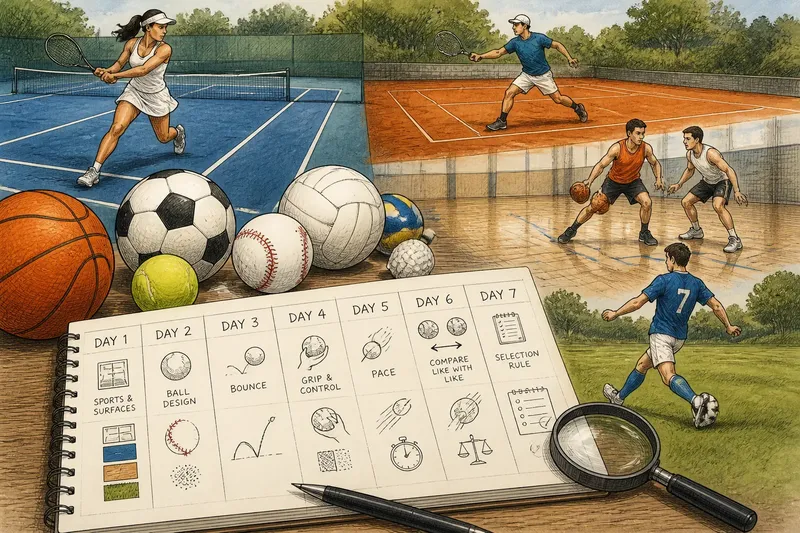
A perfect ball for every court is a myth: a ball that grips well on one surface may feel slow or behave unpredictably on another. Spend a week comparing the balls already used in your sports, and you can see how bounce, grip, and speed are trade-offs shaped by the rules and the playing surface.
The point is not to crown a winner. It is to recognize what a ball is designed to do, then choose the right approved type for the game you are playing.
Start by separating the ball from the surface
A ball’s behavior comes from its construction and the surface it meets. Cover material, seams, internal pressure or filling, size, and weight all affect how it moves and feels. The court adds its own grip, resilience, and friction.
Hard courts, indoor wood, grass, and clay do not return the same energy to a bouncing ball. A ball can rebound higher or lower, slow down more quickly, or skid differently depending on both the surface and the ball. Those differences affect how much time a player has to react.
Grip also has more than one meaning. A player needs a secure feel when holding or striking the ball, while the ball’s contact with the playing surface affects its movement. Those properties can pull in different directions: a surface-friendly ball may not feel best in the hand, and a ball that feels easy to control may not move at the desired pace.
Use one week to compare what each ball is asked to do
Keep this routine observational. Do not alter a ball or use equipment that the sport’s rules do not allow. If you are unsure which type is permitted, check the relevant governing body’s rules or the manufacturer’s instructions.
- Day one: identify the sports and surfaces. Write down the sport, court or field surface, and ball type for each session. Note whether play is indoors or outdoors, since that can change the conditions a ball encounters.
- Day two: inspect the ball’s design. Look at its cover, seams, texture, and any visible markings. Record what is printed on the ball or its packaging rather than assuming similar-looking balls share the same construction.
- Day three: observe bounce. During normal play, notice whether the ball rises predictably, stays low, or changes behavior on the surface. Avoid comparing a bounce in one sport directly with another without considering their different rules and intended play.
- Day four: observe grip and control. Notice whether players can hold, serve, catch, or strike the ball as the sport requires. Pay attention to handling during ordinary play, not just the feel of a stationary ball.
- Day five: observe pace. Watch whether the ball slows quickly, travels freely, or responds sharply to a strike. Consider how its speed affects the time and space available for the next play.
- Day six: compare like with like. Look at balls intended for the same sport and surface. If the equipment is approved for play, note any differences in how it feels or moves without treating one casual observation as a definitive ranking.
- Day seven: write a short selection rule. For each sport, record the ball type and the main property that matters for the setting, such as consistent bounce or secure handling. Use that note when choosing equipment for a similar session.
Say you play tennis on a hard court one day and practice on clay later in the week. You note the court surface and the ball marking at each session, then observe whether the ball keeps a lively bounce or slows more after contact. The useful result is not a universal verdict; it is a clearer reason to select the ball intended for that surface and setting.
Read bounce, grip, and speed as a package
Bounce is not simply a matter of “more” or “less.” A sport may call for a ball that rebounds in a consistent, readable way, while another may depend on a lower or more restrained bounce. The right behavior is the one that supports the sport’s movement and rules.
Grip must suit the actions players perform. A ball used for carrying, catching, serving, or striking presents different handling demands. Texture and seams can shape touch, but the court’s friction and the player’s technique also influence control.
Speed depends on more than how hard a player hits. The ball’s design, the surface, and the type of contact all contribute to its pace and response. Choosing for speed alone can make the ball harder to control or mismatched to the sport’s expected rhythm.
Choose for the game, not for a vague all-purpose label
A ball marketed for general recreation can be useful for informal play, but that does not make it suitable for every organized sport or court. Recreational equipment may prioritize durability or convenience, while a competition ball must meet the requirements of its sport.
When comparing options, check the sport and surface the ball is intended for, along with its markings and product description. Also consider who will use it and what kind of session they are playing. A beginner’s casual practice and a rules-based match can call for different choices even on the same court.
- Match the ball to the sport before comparing its feel.
- Check whether the product is intended for the playing surface.
- Read visible markings and the manufacturer’s description.
- Notice whether handling feels suited to the sport’s usual actions.
- Choose a ball approved for organized play when rules require it.
Which ball questions matter on a particular court?
Does the same sport use different balls on different surfaces?
Some sports distinguish equipment by surface or playing conditions, while others use a common approved ball across settings. Check the sport’s rules and equipment labeling rather than assuming that a ball suitable for one court is right for another.
Why can two balls feel different even when they look alike?
The cover, seams, internal construction, and intended use can vary while the overall appearance stays similar. Read the markings and product information to identify what each ball is designed for.
Is a softer ball always easier for beginners?
Not necessarily. A softer feel may help with one kind of contact, but bounce, pace, grip, and the demands of the activity matter too. Choose equipment suited to the learner and the sport rather than relying on softness alone.
Can one ball work for casual play across several sports?
A general-purpose ball may be fine for informal activities if players accept that it will not behave like each sport’s standard equipment. For practice that is meant to build sport-specific control, use the ball intended for that activity.
Keep the selection rule tied to the next session
After the week, keep your notes where you choose or pack equipment. A short reminder such as “court type first, sport marking next” is more useful than a claim that one ball is best everywhere.
The phrase “perfect ball for every court” hides the decision that matters: what behavior does this sport need on this surface? Use that question each time you choose, and bounce, grip, and speed become practical criteria rather than competing claims on a package.