How the Whistle Became a Sporting Signal
Explore how the sporting whistle became an officiating signal, and learn to read its sound alongside gestures, player reactions, and restart decisions.
The sporting whistle became useful because a referee’s shout could be lost in a crowded field or gym. Its history is not one universal switch from voices to whistles: adoption differed by sport, and a clear chronology requires named, verifiable milestones rather than a tidy story about every game changing at once.
The whistle joined older ways of signaling
Officials could stop play with a voice, a gesture, or a signal understood by people nearby. Those methods did not disappear when whistles entered sports; modern officials still pair audible calls with hand signals and explanations.
For a historical account, the important distinction is between the whistle as an object and its use under a sport’s rules. A whistle could be available without being part of an organized officiating code, and separate sports could adopt it at different times.
A reliable timeline needs sport-specific evidence
There is no single date that marks the whistle’s arrival in all sports. A defensible history would identify a particular sport or governing body, then verify the date and context against contemporary rulebooks, official records, or other well-supported historical sources.
Without that evidence, it would be misleading to claim that larger crowds or playing areas alone caused a general shift. The practical appeal is clear—a sharp sound can attract attention—but that explanation does not establish when a sport adopted the signal or how its rules changed.
The sound became meaningful through rules
A whistle does not explain its own meaning. The sport’s procedures determine whether it stops action, signals a restart, or serves another purpose, while the official’s gesture and any spoken explanation supply further detail.
That shared convention is what makes the sound useful to players and spectators. People learn to treat the signal as a cue to pause and look for the next instruction, rather than as a complete account of the decision.
Read the whistle with the official’s gestures
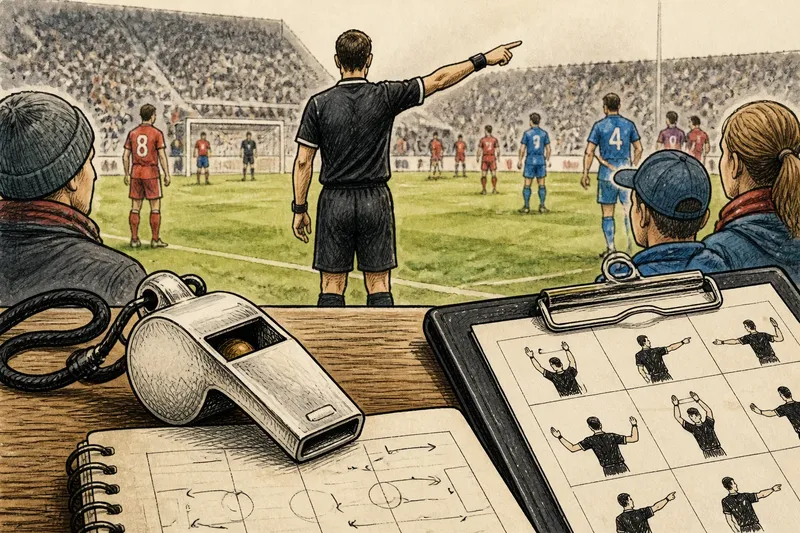
When you hear a whistle from the stands, look toward the official and then check the players’ reactions and the restart location. A pointed arm, a change in formation, or a team moving to take possession can help explain what happens next, but the exact interpretation depends on the sport.
Say you are watching a field game from behind one goal and hear a short blast while play is far away. You see the referee point toward the opposite end, and players set up for a restart there; the observable result is a clear direction for the next phase, although the whistle alone does not tell you which rule prompted it.
Whistle styles and other signals vary by sport
Officials may use whistles with an internal pea or a pea-less design, and the sound can differ between models. Sports also use other cues, including verbal calls, horns, bells, or electronic signals, where their rules and conditions call for them.
Do not assume that the length or number of blasts has the same meaning across games. Check the relevant sport’s rules or listen for the official’s accompanying gesture; those details are more dependable than applying a signal pattern learned in another sport.
What should you listen for when watching a game?
Why do officials use whistles instead of only shouting?
A whistle creates a distinct cue that can attract attention without requiring players to hear a sentence. Officials still use voices and gestures where those communicate a decision more clearly.
Does the same whistle sound mean the same thing in every sport?
No. Each sport defines its own procedures, so consult that sport’s rules and watch the official’s gesture before interpreting the signal.
How can I tell what a whistle means from the stands?
Look at the official, the players’ immediate response, and where play resumes. If those cues are unclear, the whistle tells you that something has changed, not necessarily why.
Did the whistle replace an official’s judgment?
No. The whistle communicates that a signal has been made; it neither decides what happened nor explains the rule behind the decision. Officials still apply the sport’s rules to the play.
Use the whistle as a cue to follow the next decision
When the signal sounds, note the gesture, the restart location, and which players move into position. If you want the historical story rather than the on-field meaning, look for a sport-specific source such as an archived rulebook or governing-body record before relying on a broad claim about when whistles became standard.
That approach makes the sporting whistle easier to understand without confusing a useful explanation with established history. The sound gathers attention; the sport’s rules and the official’s next cues tell you what it means.